Music Review: Coldplay – Part 1

With the recent release of Coldplay’s ninth album, Music of the Spheres, today we go take a dive into their back catalogue and review all nine albums of their discography…

Parachutes (2000)
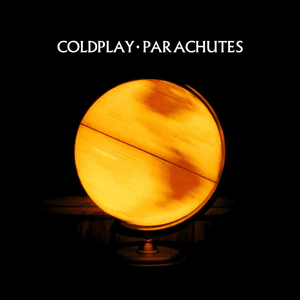

A rather subtle and muted debut, the acoustic sounds and chilled laid back vibe of the album make this a good listen for a relaxing afternoon or evening, perhaps on a rainy day. Shiver is a brilliant Jeff Buckley inspired song about unrequited love. Spies is an underrated grim track with a haunting guitar. Sparks gives the funny impression that Chris Martin is about to doze off. Yellow is outstanding in its simplicity. Everything’s Not Lost is a brilliant album closer about hope and perserverance. None of the songs have any major impact on the listener but perhaps that is the point.

Favourite song: Spies

Rating: 6/10


A Rush of Blood to the Head (2002)

Aggressive, urgent, darker, and more confident than its predecessor, this album was both a critical and commercial success upon its release in 2002. There is a strong U2 influence as well on aggressive tracks such as Politik, Daylight, and A Whisper. The use of instrumentation, such as guitars, drums, and piano, is consistently excellent throughout the album. The overarching themes of war, love, death, despair and time combined with its hard edge and tone makes for a compelling and profound listen, especially following the events of 9/11 and the Iraq War. The final two songs, A Rush of Blood to the Head and Amsterdam, are incredible. Over 20 years later, this is still arguably their best album, aging like a fine wine.

Favourite song: God Put a Smile upon Your Face

Rating: 10/10


X&Y (2005)

Coldplay X&Y.svg

Ah yes – the notoriously difficult third album. Noted for its troubled production, delayed release, and widespread anticipation, X&Y sees Coldplay explore electronic rock and pop with an influence from artists such as Kraftwerk, U2, David Bowie, and Kate Bush. Transitioning from rock tracks such as Square One, White Shadows, Talk, and Low into pop ballads such as Fix You, A Message, and The Hardest Part, the result is somewhat jarring and uneven. The uptempo rock tracks are far more effective than some of the pop ballads, which are sometimes shallow and boring. The philosophical and emotional themes of the album again, have a varying degree of effectiveness, with some of the tracks embracing their themes better than others. In comparison, the first half is far stronger lyrically and musically than the second. In particular, the last few tracks drag on for far too long, becoming boring and uninspiring. Yet the hidden track, Til Kingdom Come, finishes off the album beautifully with a tribute to the late great Johnny Cash.

Rating: 7/10

Favourite song: Low


Viva la Vida or Death and All His Friends (2008)
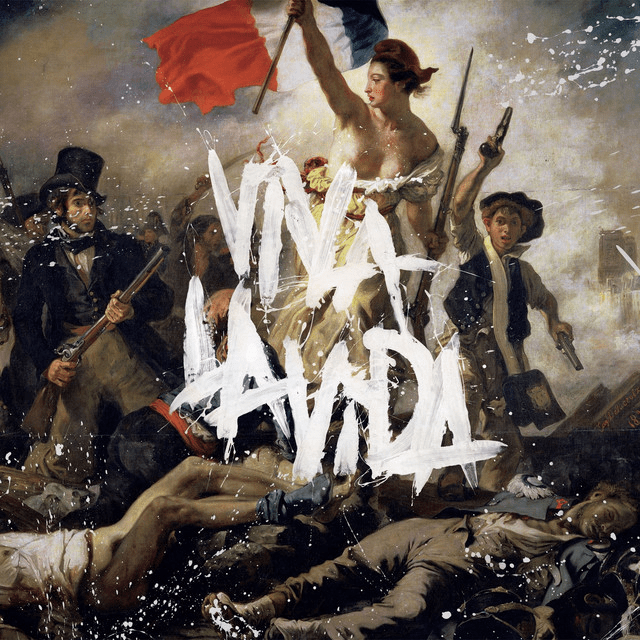

Coldplay’s fourth album sees them reach their critical, commercial, and creative peak. The band were challenged by producer Brian Eno to make every track sound lyrically and musically different, and the results paid off spectacularly. The effect is an album and sound unlike anything they have created before. Cemeteries of London is a dark odyssey into death and religion. Lovers in Japan is a gorgeously bright song about the road of love. Viva la Vida is a biblical masterpiece and ranks amongst their greatest songs. Violet Hill is a dark and grim journey into war and death. Strawberry Swing is a beautifully bouncy folk tune. Plus the hidden songs on the album are a delight to discover. There are sounds and instrumentation here that have never been heard on their songs before, such as violins, a church organ, and a variety of percussion. Additionally, the use of their regular instruments of piano, guitar, bass and drums are also extremely effective. Lyrically the songs are also more abstract, touching on themes of love, life, loss, death, and religion.

Viva la Vida or Death and All His Friends is an album bursting with ideas, innovation and sound. It shouldn’t work, but incredibly, it does.

Rating: 9/10

Favourite song: Violet Hill


Thanks for reading. Part 2, covering the albums to 2021, will be out next week.

Andrew’s Highlights #4

August – September 2021

Lockdown: 3 months and counting…

Film:

The Chronicles of Narnia: The Lion, the Witch and the Wardrobe (Andrew Adamson, 2005)

The Chronicles of Narnia: Prince Caspian (Andrew Adamson, 2008)


Harry Potter and the Philosopher’s Stone (Chris Columbus, 2001)

Harry Potter and the Chamber of Secrets (Chris Columbus, 2002)

Harry Potter and the Prisoner of Azkaban (Alfonso Cuarón, 2004)

Harry Potter and the Goblet of Fire (Mike Newell, 2005)

Harry Potter and the Order of the Phoenix (David Yates, 2007)

Harry Potter and the Half-Blood Prince (David Yates, 2009)


The Hollow Crown: Henry IV, Part 1 (Richard Eyre, 2012)

Licence to Kill (John Glen, 1989)

The World Is Not Enough (Michael Apted, 1999)


TV:

Deutschland 83 (Sundance TV, 2015)

Doctor Who: Fury from the Deep (BBC, 2020)

Friends Season 6 (NBC, 1999-2000)


Music:

“Let’s Rock” (The Black Keys, 2019)

The New Abnormal (The Strokes, 2020)

Torch the Moon (The Whitlams, 2002)

Tranquility Base Hotel & Casino (Arctic Monkeys, 2018)


Literature:

Henry IV, Part 1

William Shakespeare, ed. David Bevington (Oxford University Press, 1987)

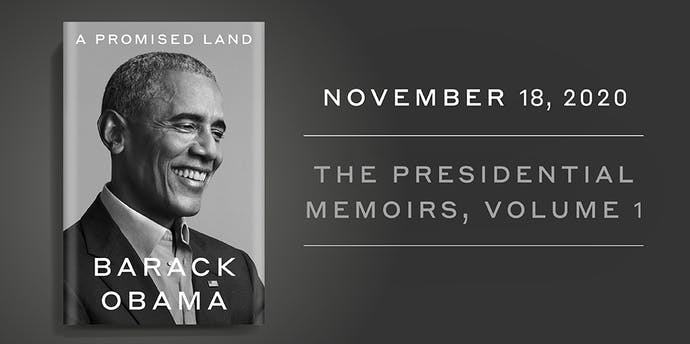
A Promised Land

Barack Obama (Viking Press, 2020)

The Lion, the Witch and the Wardrobe

C. S. Lewis (Geoffrey Bles, 1950)

Prince Caspian

C. S. Lewis (Geoffrey Bles, 1951)

Sport:

English Premier League 2021-22

Tokyo Olympics 2020

US Open Tennis Championships 2021

Film Review #4: The Chronicles of Narnia: The Lion, the Witch and the Wardrobe

“Do not cite the Deep Magic to me Witch. I was there when it was written.”

Memories and nostalgia are a funny thing. Revising the things you enjoyed in the past can often bring mixed emotions of joy, frustration, disappointment, sadness or all of the above. Last year in the height of the pandemic I was encouraged by a friend to revisit something I had enjoyed during my childhood – The Chronicles of Narnia by C.S. Lewis, although I had neither the time nor motivation to do so until recently. When I was a child, I was given a copy of The Lion, the Witch and the Wardrobe as a gift leading up to the film’s release in 2005 and thoroughly enjoyed both and book and film, but never progressed further or revisited the series. Until now…

The Chronicles of Narnia is a series of seven fantasy novels written by British author C. S. Lewis and originally published between 1950 and 1956. The books are set in the fictional world of Narnia, a fantasy realm of mythical beasts and anthropomorphic animals, and is told through the perspective of several children who visit the realm. The first of these novels, The Lion, the Witch and the Wardrobe, was originally published by Geoffrey Bles in 1950.

During the early 2000s, Disney was looking for a fantasy franchise that would rival the critical and commercial successes of The Lord of the Rings and Harry Potter. As such, The Chronicles of Narnia seemed to be the perfect candidate for adaptation to film for family audiences that would be enjoyed by both adults and children. Consequently, The Lion, the Witch and the Wardrobe was released in 2005 and was followed by two sequels, Prince Caspian in 2008, and The Voyage of the Dawn Treader in 2010.


Revisiting the film again as an adult, I can honestly say that The Chronicles of Narnia: The Lion, the Witch and the Wardrobe is a triumph of filmmaking that wonderfully introduces and transports audiences to the land of Narnia, bring its world to life.

Firstly, the film and the world of Narnia looks absolutely gorgeous, with an excellent blend of practical and visual effects. The anthropomorphic creatures and animals of Narnia all look spectacular blended in with the Narnian landscapes and backgrounds. The visual effects team have thus done an excellent job in combining CGI, practical, and visual effects throughout the film. In particular, the lion Aslan, voiced by Liam Neeson, is a visual triumph boasting some of the best CGI ever created and looks real, far better than anything from the live adaptation The Lion King. Neeson’s voice acting is also some of the best in children’s films.

The film is also superbly directed by Andrew Adamson, who manages to blend narrative, comedy and action wonderfully well. For a long runtime of 143 minutes the film is also paced extremely well, never feeling boring or dragged. The viewer is steadily introduced to the world of Narnia through the four children, and we are able to experience the wonderful (and dangerous) creatures and animals that live in this fantasy realm. It feels akin to the introduction of the Wizarding World in Harry Potter and the Philosopher’s Stone. The film also builds steadily to the climax battle which is far more detailed, exciting and magnificent than written in Lewis’ original book.

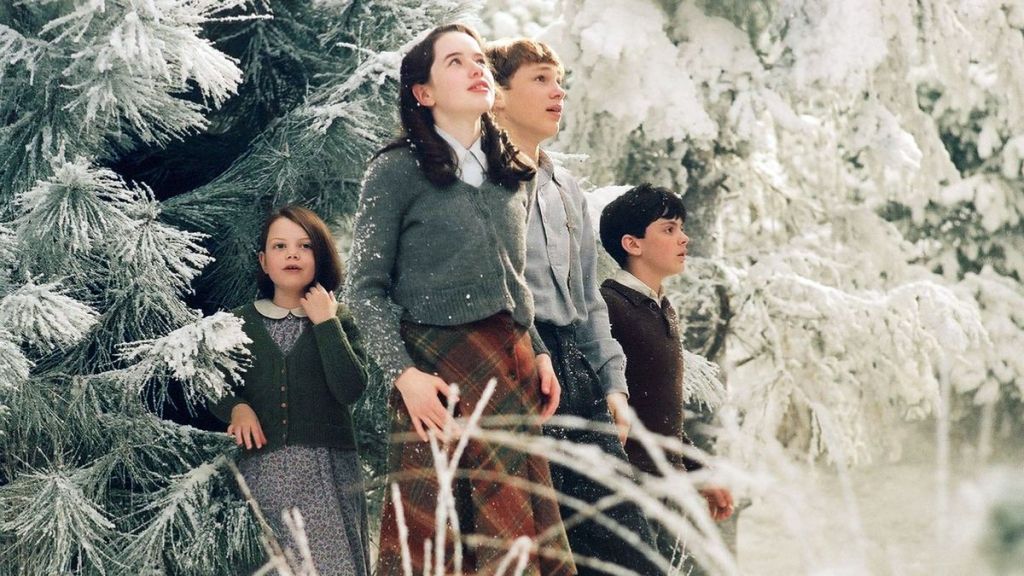
From left: Lucy, Susan, Peter and Edmund Pevensie.

In terms of acting, the performances of Tilda Swinton as the White Witch and Liam Neeson as Aslan tower above all others. Swinton is incredible as the cold-hearted, evil and manipulative Witch who holds Narnia with an icy cold grip. In every scene she is in she exudes a strong, godly and otherworldly performance as the White Witch, always supremely confident of her skills and abilities. Her white fringed gown and coat is a spectacular achievement for the costume design team. Neeson is also excellent as the voice of Aslan the lion, who is the wise, insightful and all-knowing King of Narnia. His voice always produces an aura of strength, wisdom and knowledge throughout the film.

As for the four children, unfortunately on a character level they are not very interesting and have no major story arcs or development (with the exception of Peter). Clearly Lewis (and the screenwriters) were more interested in the world of Narnia and its inhabitants than the kids. However George Henley is delightful as the young Lucy Pevensie, and her discovery and exploration of Narnia is fantastic to see, as is her interactions with Mr Tumnus (the faun) and Aslan. Out of the four, Peter is the one who undergoes the most development as he grows and develops from a young boy into a courageous and chivalrous man and soldier.

Finally, the music and soundtrack, composed by Harry Gregson-Williams, is also excellent and really allows the Narnian world to really flourish and blossom on screen. The final orchestral track, Only the Beginning of the Adventure, is one of my favourites and is well worth a listen.

The Chronicles of Narnia: The Lion, the Witch and the Wardrobe is an excellent fantasy film for both children and adults alike and is a wonderful and faithful adaptation of C. S. Lewis’ original novel. 8/10.


Book Review #3: A Promised Land

More than anyone, this book is for young people – an invitation to once again remake the world, and to bring about, through hard work, determination, and a big dose of imagination, an America that finally aligns with all that is best in us.

Barack Obama

As a fan of politics, government and international relations in general, I’ve always had a keen interest in the role that the United States of America plays on the international stage. Whilst their presence in international affairs isn’t always successful or positive, there is no doubt that they have and will continue to have a strong influence on shaping our world, and the way it operates in the 21st century. Needless to say then I was interested to read Barack Obama’s presidential memoir A Promised Land, and understand how the US Government runs and operates (both domestically and internationally) and the challenges that his administration faced.


A Promised Land is the first of two volumes of Obama’s presidential memoirs, and convers the period from his childhood to his political career in the Illinois Senate and US Senate, and culminates in his presidential years up to Operation Neptune Spear, the raid that killed bin Laden in 2011. Some of the major topics discussed in the book include his career as US Senator for Illinois; the 2008 presidential election campaign; the Global Financial Crisis; The Affordable Care Act (Obamacare); the wars in Afghanistan and Iraq; Wall Street reform; the Deepwater Horizon oil spill, the Israel-Palestine conflict; the Arab Spring; and Operation Neptune Spear.

At over 700 pages, the book seems daunting to read, even for experienced readers of non-fiction. However, Obama is an excellent writer and has a wonderful gift in being able to explain detailed policies and legislation in plain English, whilst also keeping the reader entertained. This is done through providing background and context for a particular policy/event/issue, whilst also explaining the motivations and reasons for a particular policy/meeting/decision, and the effects that it will have on the population in general. A bit like the cause-effect relationship. This allows the reader to become more educated and informed about his motivations and decisions, whilst also making the book more interesting and relatable.

There are many notable victories and failures covered throughout the book. The most significant ones however, are his victory in the 2008 presidential election, and the passage of the Recovery Act and the Affordable Care Act, which addressed the Global Financial Crisis and the healthcare system in the US. Through a magnifying lens we are able to see his motivations, belief, and disappointments in the presidential election campaign, and the ups and downs of the political rollercoaster on the road and throughout the primaries and debates. We also see the enormous challenges faced in the passing of the Recovery Act and the Affordable Care Act, due to the huge political, business and public opposition at the time. The arduous and painstaking process of drafting legislation and consultation with key stakeholders makes their eventual passing joyous and memorable, even though we know the end result already. Above all, Obama never wavers from his belief of hope for building a better America for his fellow citizens.

Yet we are also witness to his notable failures in political life. Key examples include the attempted closure of Guantanamo Bay, the ongoing Israel-Palestine conflict, immigration reform and the DREAM Act, and the losses in the 2010 midterm elections. The DREAM Act, which aimed to give undocumented child and teenager immigrants temporary legal residence and a road towards citizenship, was a significant goal for Obama and its failure to pass the US Senate is a tough pill to swallow for his team. Other failures not mentioned in the book include the anarchy in Libya after Gaddafi’s death, and the deportation of over 2 million undocumented immigrants. The worsening political situation in the Middle East after the Arab Spring is also another disaster, as is the deployment of 30,000 more troops to Afghanistan in 2009 and the deaths of soldiers on duty.

Also touched upon is the worsening political climate of Washington and the erosion of democratic norms by the Republican party, and the increasing division among Americans, which would become eventually evident in the 2016 and 2020 presidential elections. Trump also gets a brief mention towards the end, foreshadowing events to come. The final section is also excellent and reads more like a crime novel than a political memoir, without going into spoilers.

A Promised Land is an excellent political memoir by a gifted writer and is one of the best books of 2020. I look forward to the publication and release of the second volume.


Further information:

https://obamabook.com/

https://www.penguin.com.au/books/a-promised-land-9780241491515

Andrew Reviews Special: Beer!

Something a bit different today – a review of six beers from Australia and overseas in a lockdown special post.


Yep, the things people get up to during lockdown…

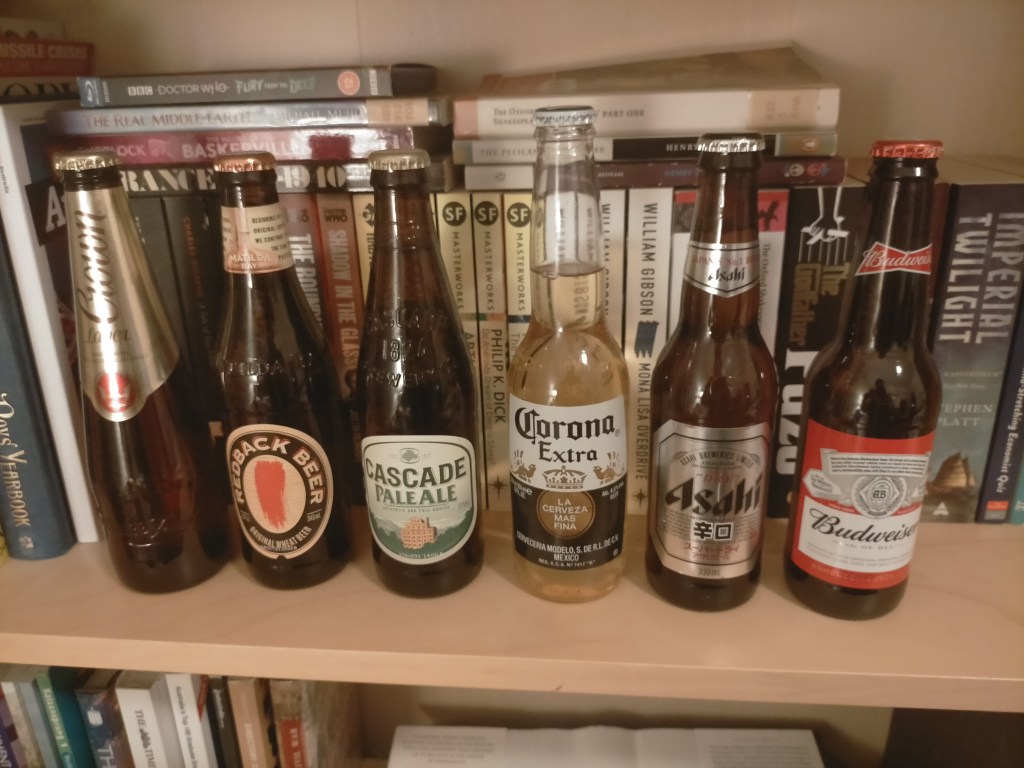
Several weeks ago my workmates kindly send me a gift set of six beers for my birthday, and I’ve decided to review them here. Cheers to that! (Please drink responsibly).

  1. Asahi Super Dry 330mL 5.0% ABV (Asahi Breweries, Japan)
  2. Budweiser 330mL 4.5% ABV (Anheuser-Busch Inc., US)
  3. Cascade Pale Ale 375mL 5.0% ABV (Cascade Brewery)
  4. Corona Extra 355mL 4.5% ABV (Cerveceria Modelo, Mexico)
  5. Crown Lager 375mL 4.9% ABV (Carlton & United Breweries)
  6. Redback Beer 345mL 4.7% ABV (Matilda Bay Brewery)

Asahi Super Dry: Originally launched in 1987, this beer transformed the Japanese beer industry and quickly became the nation’s most popular beer, with the company branding it ‘Japan’s No. 1’ . It has a cool, strong and refreshing taste with just a tiny hint of bitterness. There is a strong aftertaste of the malt and and yeast. I can definitely see why this is popular across Asia. Somewhat disappointed this is brewed in Australia though and not imported from Japan. 8/10.

Budweiser: One of America’s most famous and popular beers, they adopted the slogan ‘King of Beers’ for their brand. A high standard then, perhaps… This was my first time trying a Budweiser and unfortunately it was a disappointment. The beer was distinctly lacking in flavour and taste, and was honestly a tad bland. Perhaps this was due to it being brewed here locally rather than in the US, but for my money’s worth I’d much rather buy something else. Hopefully I’ll get to taste the original US brewed beer one day. 3/10.

Cascade Pale Ale: The Cascade Brewery is Australia’s oldest operating brewery, having being based in Hobart, Tasmania since 1824. The pale ale is one of Australia’s finest and is bursting with sweet fruity malt flavours and a tiny hint of bitterness. The head and cream is also excellent with a great and rich aftertaste. This is truly one of Australia’s (and Tasmania’s) great and most underrated beers. It is a shame that it is almost impossible to find outside Tasmania. 9/10.

Corona Extra: A beer that needs no introduction. I wasn’t the biggest fan of this several years ago during my uni days but its grown on me as I’ve grown older. A strong, crisp refreshing taste makes this a favourite across the world, especially in the Americas. Excellent served with a lime. It truly is ‘la cerveza mas fina’ (the finest beer). 7/10 (without lime).

Crown Lager: The story goes that Crown Lager was originally launched in 1954 to mark the Queen’s Royal Visit to Australia. Whatever the case, this beer has an excellent, rich taste fit for a king. Fantastic unique bottle shape and marketing too. Highly recommended in Australia. 9/10.

Redback Beer: Out of the 6 beers in this set this was the only one I hadn’t heard of before. Originally brewed in 1988 this was one of Australia’s first craft beers and was launched in Fremantle, WA. This one is a wheat beer based on traditional German wheat beer recipes. The flavour and aftertaste is strong and rich, with the wheat taste noticeable. There is also an excellent cream and head. This would be a fantastic drink with mates on a hot summers day. Unfortunately this is a hard one to find in Australia outside Western Australia but if you can get your hands on one it’s highly recommended. 8/10.

Favourite beer: Cascade Pale Ale.

Andrew’s Highlights #3

July 2021: Lockdown Edition

Film:

Dr. No (Terence Young, 1962)

Thunderball (Terence Young, 1965)

On Her Majesty’s Secret Service (Peter Hunt, 1969)

The iconic gun barrel sequence from Dr. No.

TV:

Doctor Who: The Deadly Assassin (BBC, 1976)

Superwog Series 2 (ABC, 2021)


Music:

Beethoven: Symphony No. 6 in F Major ‘Pastoral’ (Berlin Philharmonic, 2015)

Beaucoups of Blues (Ringo Starr, 1970)

Cloud Nine (George Harrison, 1987)

Crowded House (Crowded House, 1986)

Introducing The Whitlams (The Whitlams, 1993)

Paint the Sky with Stars – The Best of Enya (Enya, 1997)

The Very Very Best of Crowded House (Crowded House, 2010)

Together Alone (Crowded House, 1993)

Turn Blue (The Black Keys, 2014)


LOCKDOWN CLASSICS:

AM (Arctic Monkeys, 2013)

A Rush of Blood to the Head (Coldplay, 2002)

Dark Sky Island (Enya, 2015)

Eternal Nightcap (The Whitlams, 1997)

Normal F*cking Rockwell! (Lana Del Rey, 2019)

The Beatles (White Album) (The Beatles, 1968)


Literature:

Unfinished Tales of Númenor and Middle-earth: 40th Anniversary Edition (J.R.R. Tolkien, ed. Christopher Tolkien, 2020)


Sport:

Copa America 2021 – Champions: Argentina

Euro 2020 – Champions: Italy

State of Origin 2021 – Winners: NSW 2-1

Tokyo Olympics 2020

West Indies vs Australia T20I Series – Winners: West Indies 4-1

Book Review #2: On Her Majesty’s Secret Service

“Bond’s right hand flashed out and the face of the Rolex disintegrated against the man’s jaw.”


On Her Majesty’s Secret Service is the tenth James Bond novel by Ian Fleming, and was originally published in 1963. It is the second book in the Blofeld/ SPECTRE trilogy, which began with Thunderball and concludes with You Only Live Twice.

Following the events of Thunderball, Bond has been tasked by MI6 to find Ernst Stavro Blofeld, and the members of his criminal organisation, SPECTRE. His mission is to pose as a genealogist at the College of Arms and travel to Blofeld’s alpine base in Switzerland to stop a plan that will destroy Britain from the inside. Little does he know that victory will bring tragic consequences…

The original first edition cover, published in 1963 by Jonathan Cape.

I was interested to see where Fleming would take the organisation of SPECTRE and its chief mastermind Blofeld, having really enjoyed Thunderball. Thankfully, overall this is one of the stronger Bond novels with some minor detractions.

Firstly, this is one of the best portrayals of the character of Bond and his story. Fleming dedicates a serious chunk of the novel in developing a more caring, reserved and human side of his character that is rarely explored in the previous novels. We also get a rare glimpse into Bond’s childhood and origins which is fantastic to read.

The book also introduces the character of Tracy (Teresa di Vicenzo) and her father Marc-Ange Draco, who play prominent supporting roles in the novel. The interactions and relationship between Bond and Marc-Ange always feel warm and joyous (akin to his relationship with Felix Leiter) and Marc-Ange plays a prominent role in supporting Bond in his mission to take down Blofeld and his criminal associates. Unfortunately the character of Tracy is sadly underdeveloped (she makes brief appearances in the book), and Bond’s subsequent attraction and relationship with her feels a tad unbelievable in some ways. Nevertheless, there are some wonderful scenes of them together though, with some fantastic dialogue and banter.

Of the other supporting characters, Bond’s chief M also plays a larger role than in other novels, with some fantastic insights into his private life when Bond visits his house during Christmas.

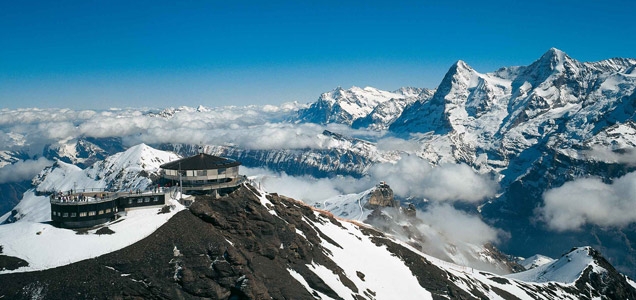
Piz Gloria, Blofeld’s alpine hideout.

The best aspect of the book however, are the action scenes. Fleming manages to tone down some of the more obnoxious aspects of his previous novels (racism, sexism, snobbery, etc) and fully dedicates the book to some gorgeous and fantastic scenes of action and violence. In particular, the ski chase and skeleton bobsled sequences down the Swiss Alps are some of the best chapters of the entire series. There is real tension and danger here, and a high likelihood that Bond will not make it out in one piece.

Here is a brief except:

“First there came a deep boom from high up the mountain, and a speck of flame, that wobbled in its flight, soared into the sky above him. There was a pause at the top of its parabola, a sharp crack, and a blazing magnesium flare on a parachute began its wandering descent, wiping out the black shadows in the hollows, turning everything into a hideous daylight.”

Which brings me to the final aspect of the review – of Blofeld, SPECTRE, and the antagonists. Unfortunately this is a bit of a letdown. Whilst Blofeld, his henchwoman, Irma Bunt, and the girls at Piz Gloria are all developed well, his meeting with Bond and his ‘master plan’ are a tad underwhelming and ridiculous. In particular, it is unlikely that a character as private, unseen and reserved as Blofeld would simply agree to a meeting with a government official to assume some family titles and inheritances, given his extraordinary wealth already from SPECTRE. His master plan to destroy Britain is also ludicrous (without going into spoilers), whilst the first meeting with Bond is also a tad anticlimactic, given what we’ve previously been told about this incredible man.

Regardless, On Her Majesty’s Secret Service is still a fantastic novel in the James Bond series and is highly recommended for the action/crime fan. The action sequences in particular are the peak of the series.

Rating: 8/10


Also some brief thoughts on the 1969 film: Absolutely marvelous. Truly one of the best and most underrated Bond films of all time. George Lazenby and Diana Rigg are excellent. The ski chases and action sequences are beautifully shot, with some gorgeous cinematography. The film even manages to improve some aspects of the book (e.g. Tracy’s character gets a major upgrade). The soundtrack by John Barry is also arguably the best in the series. Just listen to the opening theme!

Andrew’s Highlights #2

May/June 2021

30 June 2021

Film:

Atonement (Joe Wright, 2007)

Lawrence of Arabia (David Lean, 1962)


TV:

Doctor Who: The Power of the Daleks (BBC, 1966; 2020)

Eurovision Song Contest 2021

The Grand Tour Season 1 (Amazon Prime Video, 2016-17)


Music:

ABC Classic 100 2021

A/B (Kaleo, 2016)

Delta Kream (The Black Keys, 2021)

Dreamers Are Waiting (Crowded House, 2021)

Elysium (Pet Shop Boys, 2012)

The Ol’ Razzle Dazzle (Missy Higgins, 2012)

Woodface (Crowded House, 1991)


Literature:

On Her Majesty’s Secret Service (Ian Fleming, 1963) (James Bond #11)


Sport:

A-League Grand Final – Melbourne City vs Sydney FC

New Zealand vs England First Test – Lord’s, London

New Zealand vs England Second Test – Edgbaston, Birmingham

State of Origin 2021 – NSW vs QLD

UEFA Champions League Final 2021 – Manchester City vs Chelsea

World Test Championship Final: India vs New Zealand – The Rose Bowl, Southampton

Album Review #1: Crowded House – Dreamers Are Waiting


Just some brief thoughts on one of my favourite albums so far this year.

Yes Crowded House are BACK after an 11 year absence since their last album Intriguer in 2010, with both a new lineup and album. The house has been renovated. The band’s new lineup now includes original members Neil Finn and Nick Seymour along with Neil’s sons Liam and Elroy Finn and original producer Mitchell Froom.

The band’s new linup for 2021 – Nick Seymour, Elroy Finn, Mitchell Froom, Neil Finn and Liam Finn.

The new album, Dreamers Are Waiting, is a fantastic and delightful listen from opening song Bad Times Good to closer Deeper Down. Once again, it defines Neil Finn as a timeless outstanding singer songwriter, with the unique ability to reinvent the band’s sound not once, but twice since the band’s original lineup in the 1980s and 90s.

Needless to say this album was produced and recorded before and during the Covid-19 pandemic, and some of the themes reflect this about darkness, escapism and disappearing into other worlds on songs such as To The Island and Show Me The Way. The album is complemented with some fantastic, strange, and sometimes sinister acoustic sounds and melodies, which are complemented by Neil’s entrancing and relaxing voice. Listening to the album in full gives one a hypnotic and relaxing feeling both at once.

Dreamers Are Waiting is a fantastic return album for Crowded House with some excellent sounds and melodies and is my pick for Album of the Year so far for 2021.

Also big shoutout to bassist Nick Seymour for some AMAZING album artwork.

Favourite songs: To The Island, Sweet Tooth, Goodnight Everyone, Show Me The Way, Real Life Woman.


Rating: 8/10


Andrew’s Highlights #1

March/April 2021

2 May 2021

Film:

The Godfather Coda: The Death of Michael Corleone (Francis Ford Coppola, 2020)

Gone With the Wind (Victor Fleming, 1939)

The Invisible Man (Leigh Whannell, 2020)

Train to Busan (Yeon Sang-Ho, 2016)

Infernal Affairs (Andrew Lau & Alan Mak, 2002)

The Hollow Crown: Richard II (Rupert Goold, 2012)

Reservoir Dogs (Quentin Tarantino, 1992)


Music:

Innerspeaker (Tame Impala, 2010)

El Camino (The Black Keys, 2011)

Kick (INXS, 1987)


Literature:

Space Odyssey: Stanley Kubrick, Arthur C. Clarke and the Making of a Masterpiece (Michael Benson, 2018)

Asia’s Reckoning: The Struggle for Global Dominance (Richard McGregor, 2017)

Richard II: The Oxford Shakespeare (William Shakespeare, ed. Anthony B. Dawson & Paul Yachnin, 2011)